
Introduction: The Most Complex Object in the Known Universe
Our consciousness—our mind somehow arising from matter—remains a profound mystery. Our thinking, emotions, and actions fascinate us. Outer space staggers us with its enormity. But inner space enthralls us.Quote— David G. Myers & C. Nathan DeWall
Psychology
The scientific study of behavior and mental processes.Behavior encompasses anything we do that can be externally observed. Mental processes are our internal, subjective experiences, such as thoughts, feelings, and beliefs.
Why Intuition and Common Sense Are Not Enough
The Scientific Attitude and Critical Thinking
The Three Pillars of the Scientific Attitude
To separate meaningful facts from fiction and overcome their own cognitive biases, psychologists rely on three core traits:
- Curiosity: A constant desire to ask questions, explore, and understand mechanisms without being misled.
- Skepticism: A healthy, relentless questioning of claims. Asking fundamental questions like: "What exactly do you mean by that? What is your evidence for it?"
- Humility: An awareness of our own vulnerability to error. An openness to admit that our predictions might be wrong and that empirical facts are more important than our own egos or initial hypotheses.
The Biopsychosocial Approach: The Human as a Connected Whole
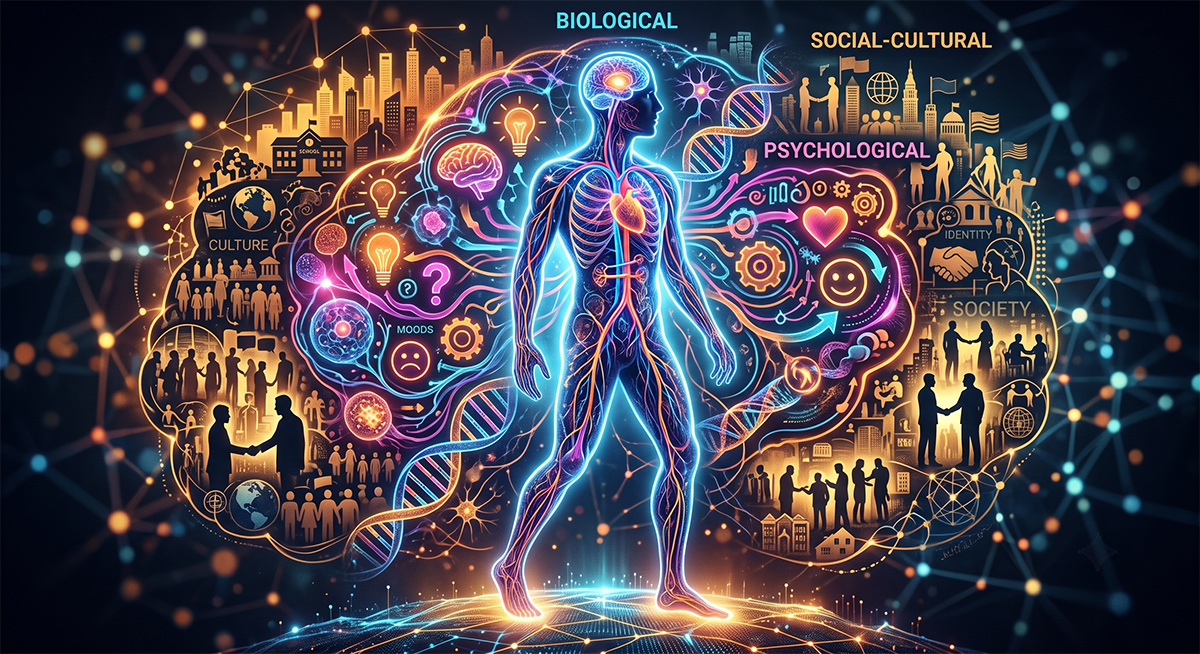
A highly detailed conceptual illustration of the human silhouette divided into three interacting layers: biological (glowing DNA strands and neural networks), psychological (symbols of thoughts and emotions), and social-cultural (silhouettes of other people and societal structures), glowing macro-photography style, neon highlights, 8k resolution, cinematic lighting] -->
Human behavior is immensely complex and is very rarely caused by a single factor. Imagine trying to explain why someone developed severe depression. Was it due to a lack of serotonin in the brain? Or their pessimistic way of thinking? Or perhaps due to the loss of a loved one and social isolation?
The answer is: all of these play a role. To fully understand mental processes, modern psychologists utilize the biopsychosocial approach. This framework recognizes that we are intertwined systems and that we must approach any phenomenon from three distinct but complementary levels of analysis.
Biological Influences
The Two Faces of Psychology: Basic vs. Applied Research
Basic Research
- Aims to expand the theoretical knowledge base and discover natural laws.
- Driven by pure curiosity and the desire to understand the fundamental principles of behavior and the mind.
- Explores questions like: How exactly does short-term memory work? What are the neurological roots of fear?
- Typically conducted in strictly controlled laboratory and academic settings.
Applied Research
- Aims to directly utilize psychological knowledge to solve specific, practical problems.
- Driven by the need to immediately improve human quality of life, health, performance, and well-being.
- Explores questions like: How can we design safer airplane cockpits? How do we best treat clinical depression?
- Typically conducted in hospitals, schools, corporations, prisons, and therapy centers.
Conclusion and Looking Ahead
References
David G. Myers & C. Nathan DeWall•Psychology (13th Edition)
Susan Nolen-Hoeksema, Barbara L. Fredrickson, Geoff R. Loftus, Willem A. Wagenaar•Atkinson & Hilgard's Introduction to Psychology (15th Edition)
B. R. Hergenhahn & Tracy Henley•An Introduction to the History of Psychology (8th Edition)