Perception is the complex process of selecting, organizing, and interpreting sensory information, which allows us to understand the surrounding world. While sensation is the passive reception of data, perception is the active process through which the brain gives meaning to that data.
In psychology, we distinguish between two closely related processes: sensation and perception. Sensation represents the capture of energy from the external environment by receptors (eye, ear) and its conversion into a neural impulse. Perception is the subsequent interpretation of this impulse in the brain.
Basics of Psychophysics and Thresholds
Psychophysics examines the relationship between the physical properties of stimuli and our subjective experience of them. The key concepts are sensory thresholds.
Sensory ThresholdsPsychophysics
Absolute threshold
The minimum intensity of a stimulus that a person is able to reliably register (in 50% of cases).
Difference threshold (JND)
The smallest detectable difference between two stimuli (Just Noticeable Difference).
Subliminal perception
The perception of stimuli that are below the threshold of absolute conscious awareness, yet can still influence the psyche.
Ernst Heinrich Weber1795–1878Weber-Fechner Law
Weber discovered that the ability to distinguish the difference between two stimuli depends on their initial intensity. The stronger the original stimulus, the greater the change must be for us to notice it.Formula: $\Delta I / I = K$ (where $I$ is intensity and $K$ is a constant for the given sense).
Exam Trap
Weber's law reliably applies only to stimuli of medium intensity. At extremely low or extremely high intensities (e.g., blinding light), this linear relationship fails.
Physiology of Vision and Color Theories
Vision is the dominant sense for humans, providing up to 80% of information about the surroundings.
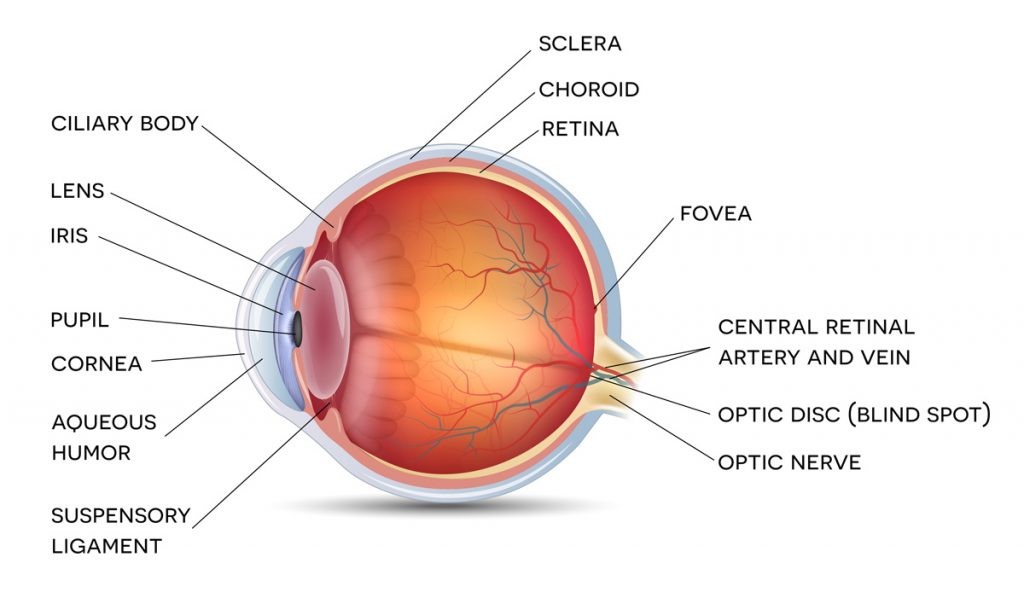
Anatomy and Receptors of the EyeBiological Basis
Rods
Specialized for dim light and movement
High sensitivity to light
Inability to distinguish colors
Located on the periphery of the retina
vs
Cones
Specialized for colors and details
Require good light intensity
Three types (red, green, blue)
Concentrated in the fovea (yellow spot)
Exam Trap
Beware of the difference between the Fovea (Yellow spot) – the area of sharpest vision with the highest concentration of cones, and the Blind spot – the area where the optic nerve leaves the eye and there are no receptors.
Color PerceptionTheories of Vision
There are two basic theories that are today viewed as complementary:
Young-Helmholtz Trichromatic Theory
Proposes three types of cones sensitive to blue, green, and red light.
Hering's Opponent-Process Theory
Color perception works on the principle of antagonism (red-green, blue-yellow, black-white). It explains the occurrence of afterimages.
Purkinje Effect
The shift of the eye's sensitivity towards blue-green light in dim conditions. In daylight, we perceive yellow as the brightest; at dusk, blue.
Gestalt Laws of Perception
Gestalt psychologists (Wertheimer, Köhler, Koffka) argued that the whole is greater than the sum of its parts. Our perception automatically organizes stimuli into meaningful wholes (gestalts).
Laws of Perceptual OrganizationGestalt Psychology
Law of Pragnanz (Good Figure)
The tendency to perceive stimuli in the simplest way possible (e.g., we see a circle even if it is slightly incomplete).
Law of Proximity
Stimuli that are close to each other are perceived as a group.
Law of Similarity
Similar elements (in shape, color) are logically grouped together.
Figure-Ground Relationship
The ability to distinguish a dominant object (the figure) from the rest of the visual field (the background).
Reversible figures
Images where the figure and the background can alternate (e.g., Rubin vase or Necker cube).
Illusions and Perceptual Disorders
Perception is not a perfect mirror of reality. It is often subject to distortions that paradoxically help us understand how the brain works.
Illusion
A distorted perception of a real stimulus (e.g., a stick submerged in water looks bent).
Hallucination
A false perception without the presence of an external stimulus. It is a pathological phenomenon (e.g., in psychoses).
Phi-phenomenon
The illusion of movement created by a rapid succession of static images (the basis of film and neon signs).
Autokinetic illusion
The apparent motion of a stationary point of light in complete darkness.
Geometric and Spatial IllusionsVisual Illusions
Ames room
A specially constructed room that creates the illusion of an extreme difference in the height of people standing in its corners.
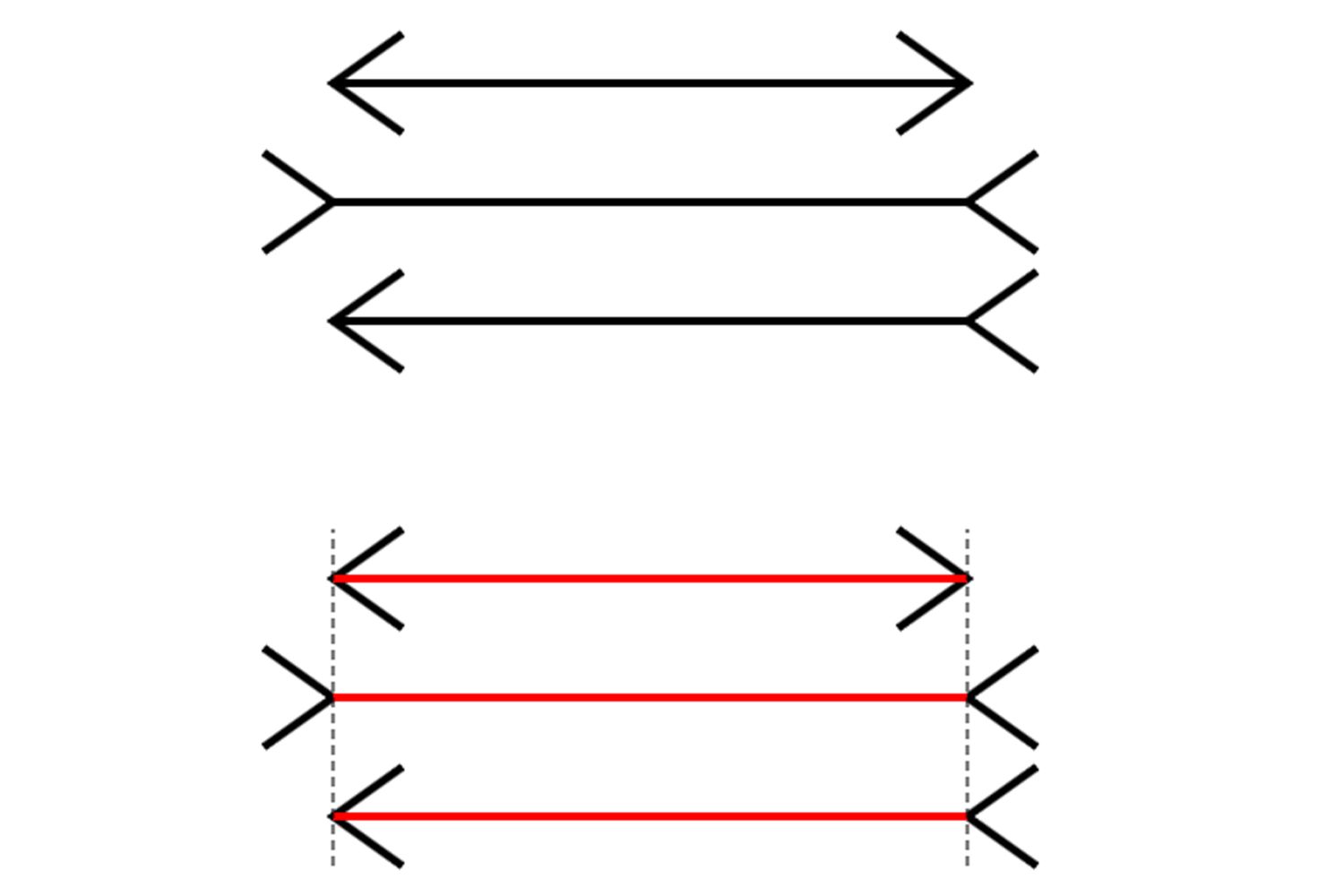
Müller-Lyer illusion
Line segments of the same length appear to be of different lengths due to the arrows at their ends.
Key Takeaways
Sensation vs. Perception: Sensation is the reception of data (receptors), perception is its interpretation (brain).
Weber-Fechner Law: Expresses the relationship between stimulus intensity and the perceived difference; fails at extremes.
Visual Receptors: Rods (black and white, dim light), cones (colors, details, fovea).
Gestalt Psychology: The whole is primary; laws of proximity, similarity, and Pragnanz govern the organization of percepts.
Illusion vs. Hallucination: An illusion requires a real stimulus; a hallucination occurs without one.
What is the main difference between the Weber-Fechner law and reality at extreme values of stimulus intensity?
Correct Answer: The law does not apply at extreme values and its predictions fail.Explanation: The Weber-Fechner law assumes a constant ratio between a stimulus and its change, which works perfectly in the middle range of intensities. However, for very weak or very strong stimuli, human sensitivity changes non-linearly, which is a typical exam trap.
Within the psychopathology of perception, we distinguish two conditions. The first is a misinterpretation of a real object, the second is a perception without any object. What are these conditions called?
Correct Answer: Illusion and hallucination.Explanation: An illusion is a distortion of reality (the object exists, but we perceive it incorrectly), whereas a hallucination is the creation of a new "reality" in the mind without any external sensory input.