Attention, memory, and learning are closely intertwined cognitive processes that allow us to select information from the external environment, store it, and adaptively change our behavior and experiences based on it.
Without attention, our minds would be overwhelmed by the surrounding chaos; without memory, we would constantly live only in the present moment with no identity; and without learning, we would be unable to adapt to the changing conditions of the world.
Attention
Attention is a psychological state that ensures the focus and concentration of our consciousness on a specific internal or external stimulus.
Tenacity
The ability to maintain attention on a single object or activity for a prolonged period.
Capacity
The amount of stimuli we can clearly perceive simultaneously (usually 4–5 objects).
Vigilance
The readiness to capture new stimuli and the ability to quickly shift attention to an important stimulus.
Oscillation
Spontaneous, short-term shifting and fluctuating of attention intensity (e.g., when staring at a single point, it seems to briefly disappear).
Selectivity
The ability to focus on one essential stimulus while ignoring other unimportant or distracting influences.
Exam Trap
Cocktail party phenomenon: This is a classic, textbook example of selective attention. It represents a person's ability in a noisy environment (e.g., at a party) to filter out and ignore the surrounding conversations of many people, yet immediately and automatically pay attention if someone says their name from a distance.
Memory and Forgetting
Memory is the complex cognitive process of encoding, storing, and retrieving information and experiences.
1
Encoding
The process of converting sensory information from the external environment into a form that the brain can process and store as a memory trace.
2
Storage (Retention)
The maintenance of information in memory systems over time. Consolidation can occur, but also fading and forgetting of the trace.
3
Retrieval
The recalling and recovering of previously stored information from memory for current thinking or action.
Memory is divided into three basic systems:
Sensory memory: Holds a massive amount of information from the senses for only fractions of a second (iconic for sight, echoic for hearing).
Short-term (Working) memory: Retains information for a few seconds to minutes; used for current conscious processing and problem-solving.
Long-term memory: Used for the permanent storage of information and is divided into declarative (explicit) memory for conscious facts and episodes from our lives, and non-declarative (implicit) memory, which is unconscious and stores our motor skills and habits.
George A. Miller1920–2012Cognitive Psychology
An American psychologist who described the capacity of short-term memory as the magic number 7 ± 2. This means that an adult can simultaneously hold an average of five to nine meaningful units (chunks) in short-term memory.
Hermann Ebbinghaus1850–1909Memory Research
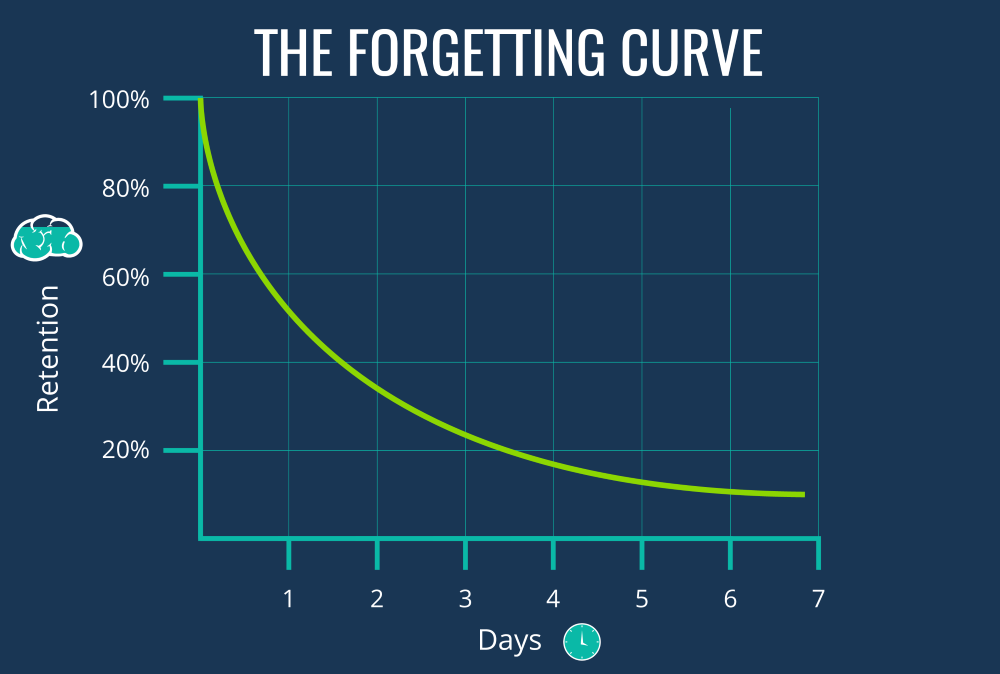
A German pioneer in memory research. Based on the mechanical learning of nonsense syllables, he constructed the famous forgetting curve. He found that the forgetting process is not linear – the steepest drop in retained information occurs immediately (in the first few hours) after learning, and only then does the rate of forgetting gradually slow down and level off.
Memory Disorders and Exam TrapsPsychopathology and Memory
Retrograde amnesia
Loss of memory for events that immediately preceded a brain injury or trauma.
Anterograde amnesia
The inability to form and store new long-term memories from the moment of injury or onset of an illness (e.g., the famous patient H.M.).
Zeigarnik effect
The phenomenon where we remember uncompleted and interrupted tasks significantly better than completed ones because they maintain psychological tension within us.
Exam Trap
Anterograde amnesia and implicit memory: Even though a patient with severe anterograde amnesia loses the ability to form new conscious memories (declarative memory is impaired and the patient doesn't know what they did five minutes ago), their ability to learn new motor skills (implicit memory) usually remains intact!
Exam Trap
Interference: - Proactive interference: Older (previously learned) information interferes with and makes it harder to remember new information (e.g., habitually writing the old year in January).
Retroactive interference: Newly acquired information interferes with and overwrites the ability to recall older information (you learn a new vocabulary lesson and consequently forget the vocabulary from the previous one).
Learning and Conditioning
Learning is a relatively permanent change in behavior or behavior potential that occurs as a direct result of an organism's experience. It includes both simple and very complex forms.
Habituation
Weakening of the response to a repeated stimulus
We learn to ignore harmless and unimportant stimuli
Example: We stop noticing the ticking of a clock in a room
vs
Sensitization
Strengthening of the response to a repeated stimulus
Usually occurs with threatening or painful stimuli
Example: The sound of a dripping faucet irritates us more and more
Ivan Petrovich Pavlov1849–1936Classical Conditioning
A Russian physiologist and Nobel laureate who discovered the principles of classical conditioning (learning based on the temporal association of two stimuli). A neutral stimulus (a bell) repeatedly paired with an unconditioned stimulus (food) eventually becomes a conditioned stimulus, which by itself can elicit a conditioned response (salivation).
Generalization
The subject reacts with the learned response to stimuli that are similar to the conditioned stimulus (e.g., salivating to a similar bell tone).
Extinction
If the conditioned stimulus is not accompanied by the unconditioned stimulus (food) for a longer period, the conditioned response will gradually weaken until it completely disappears.
B. F. Skinner and E. L. ThorndikeBehaviorismOperant Conditioning
Edward L. Thorndike first formulated the Law of Effect: Behavior that leads to positive and satisfying consequences is more likely to be repeated in a similar situation.
Burrhus F. Skinner expanded on this with his concept of operant (instrumental) conditioning. He investigated how behavior is shaped and controlled by its consequences (conducting experiments on animals in a special Skinner box).
Positive reinforcement
Adding something pleasant immediately after the desired behavior (a reward – a rat gets a food pellet).
Negative reinforcement
Removing something unpleasant after the desired behavior (e.g., turning off an unpleasant electric shock after a rat presses a lever).
Wolfgang Köhler1887–1967Insight Learning
One of the founders of Gestalt psychology. During experiments with the chimpanzee Sultan on the island of Tenerife, he described a more complex cognitive form of learning – insight learning. This is not mechanical trial-and-error learning, but a sudden cognitive understanding of the whole situation and the relationships between objects (when an animal suddenly figures out how to join sticks to get a banana, referred to as an Aha-experience).
Albert Bandura1925–2021Observational Learning
A prominent Canadian-American psychologist and author of the social learning theory. He described observational learning, or learning by observing and imitating the behavior of social models. In his groundbreaking Bobo doll experiment, he demonstrated that children who observed an adult behaving aggressively toward a toy subsequently spontaneously exhibited the exact same form and level of physical aggression.
Key Takeaways
Attention: Acts as a filter for our mind and is characterized by properties such as tenacity, capacity, vigilance, oscillation, and selectivity.
Memory: Its functioning consists of three phases: encoding, storage, and retrieval. The division of long-term memory into declarative (conscious) and non-declarative (unconscious implicit) is of particular importance.
Capacity and Forgetting: G. A. Miller determined the capacity of short-term memory to be the "magic number" 7 ± 2 items. H. Ebbinghaus experimentally proved with the forgetting curve that we forget the most information immediately after learning it.
Memory Traps: Anterograde amnesia destroys the ability to store new life episodes, but it does not impair the learning of new motor skills. In terms of interference, we distinguish between proactive (where old interferes with new) and retroactive (where new interferes with old).
Forms of Learning: Beginning with the primitive mechanisms of habituation and sensitization, continuing through classical and operant conditioning (where associations, consequences, and reinforcement play key roles), and culminating in cognitively demanding insight learning (Köhler) and observational modeling (Bandura).
Imagine you are learning a new foreign language at school, such as Spanish. While trying to recall Spanish vocabulary, Italian words that you fluently mastered five years ago keep forcing their way into your mind. What psychological phenomenon best and most accurately describes this memory state?
Correct Answer: Proactive interferenceExplanation: Proactive interference occurs when previously and strongly learned information (in your case, long-standing Italian) proactively disrupts and blocks the acquisition and retrieval of newer information (Spanish). Conversely, retroactive interference would occur if learning the new Spanish began to overwrite and disrupt your old Italian knowledge.
Following the surgical removal of his hippocampus, patient H.M. suffered a severe and irreversible form of amnesia. From that moment on, he could not remember his doctor's name or what he had for lunch ten minutes ago. However, when experimenters repeatedly had him perform the task of tracing a shape by looking at its reflection in a mirror every day, he visibly improved at this activity each day, even though he didn't recognize the training episode from the previous day at all. What type of amnesia did H.M. suffer from, and what specific subtype of memory remained intact?
Correct Answer: Anterograde amnesia and intact non-declarative (implicit) memory.Explanation: Anterograde amnesia is a pathological condition where a person permanently loses the ability to form and consolidate new conscious memories after a brain injury or surgery (declarative episodic memory is impaired). However, learning new motor and procedural skills, which are stored in non-declarative (implicit) memory, usually remains fully functional because these memory pathways do not require the hippocampus to store information.