Consciousness is a state of awareness in which an individual is aware of themselves, their thoughts, feelings, and stimuli from the external environment. It involves monitoring (tracking oneself and the surroundings) and control (planning and initiating behavior).
Consciousness is not a static state; throughout the day and night, we pass through various levels and states, from full alertness to sleep, and even states induced by meditation or psychoactive substances.
Levels of Consciousness
In psychology, particularly under the influence of psychoanalysis, we distinguish different degrees of accessibility to our mental contents.
Topographic Model of ConsciousnessSigmund Freud
Conscious
Contents that we are fully aware of and focused on at a given moment.
Preconscious
Contents (memories, knowledge) that are not currently in conscious awareness but can be easily recalled.
Unconscious
A vast area of the psyche containing repressed drives, traumas, and thoughts that are normally inaccessible to consciousness but influence our behavior.
Circadian Rhythm
A biological cycle with a period of approximately 24 hours that governs fluctuations in body temperature, hormone levels (melatonin), and the alternation between wakefulness and sleep. It is influenced by light hitting the retina.
Sleep and Dreams
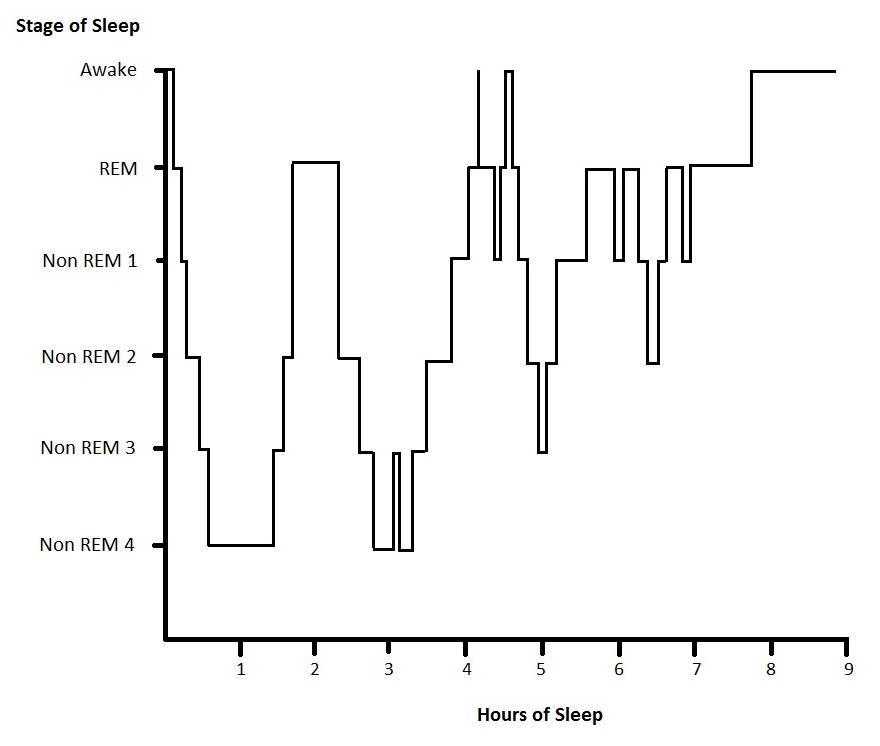
Sleep is not a passive state of being "turned off" but an active process essential for physical and psychological regeneration. We distinguish two main phases that alternate cyclically (one cycle lasts approximately 90 minutes).
Stages of SleepSleep Cycle
NREM Sleep
Serves physical regeneration and growth
Muscle tension is present
Brain activity is low
Includes stages 3 and 4 (deep sleep)
vs
REM Sleep
Serves psychological regeneration and memory sorting
Accompanied by rapid eye movements
Brain activity similar to wakefulness
Vivid dreams occur
Exam Trap
REM Sleep Paradox: The REM phase is called "paradoxical" because while the brain exhibits high electrical activity comparable to a waking state, the body (skeletal muscles) is in a state of deep paralysis (atonia) to prevent the physical acting out of dreams.
Sigmund Freud1856–1939Dream Interpretation
Freud considered dreams to be the "royal road to the unconscious". He distinguished two types of dream content:
Manifest content: What we remember from the dream and what seemingly happens in it.
Latent content: The hidden, true symbolic meaning of the dream that reveals unconscious wishes.
Sleep Disorders
Disruptions to the sleep cycle have a significant impact on cognitive performance and overall health.
Insomnia
Difficulty falling asleep or staying asleep, leading to daytime fatigue.
Narcolepsy
Sudden and uncontrolled episodes of falling asleep (directly into the REM phase) during the day.
Sleep Apnea
Repeated cessations of breathing during sleep, leading to frequent awakenings and oxygen deprivation.
Somnambulism
Sleepwalking – a state in which a person moves or performs complex activities while asleep.
Exam Trap
When does sleepwalking occur? Somnambulism (sleepwalking) occurs exclusively during DEEP NREM sleep (stages 3 and 4), usually in the first third of the night. Sleepwalking NEVER happens during the REM phase because in REM, the muscles are paralyzed, making body movement impossible!
Altered States of Consciousness and Drugs
Altered states of consciousness can occur spontaneously, through techniques (hypnosis), or chemically.
Tolerance
A state in which the body requires increasingly higher doses of a substance to achieve the original effect.
Hypnosis
A state of increased suggestibility and deep relaxation induced by a hypnotist.
Classification of Psychoactive SubstancesDrugs
1
Depressants
Slow down the activity of the central nervous system. This group includes alcohol, barbiturates, and opiates (heroin, morphine).
2
Stimulants
Speed up psychological and physical processes and increase alertness. This group includes caffeine, nicotine, amphetamines, cocaine, and methamphetamine.
3
Hallucinogens
Cause distortions in perception, hallucinations, and changes in thinking. This group includes LSD, psilocybin (magic mushrooms), or marijuana.
Exam Trap
Alcohol is a depressant! Although people may behave loudly and feel relaxed after consuming alcohol, from a pharmacological perspective, alcohol is a depressant. The relaxed behavior is caused by the fact that alcohol primarily suppresses the brain centers responsible for social inhibitions and self-control.
Key Takeaways
Consciousness: Monitors the surroundings and controls behavior; Freud divides it into conscious, preconscious, and unconscious.
Circadian Rhythm: A 24-hour internal biorythm governed by light and melatonin.
Sleep Phases: The alternation of NREM (body regeneration) and REM (dreams, brain activity, muscle paralysis).
Sleepwalking: Occurs in deep NREM sleep, not in REM.
Drugs: Alcohol belongs to the depressant category, not stimulants.
Why is the REM stage of sleep referred to as paradoxical, and what physiological state does it induce in skeletal muscles?
Correct Answer: The brain is as active as in wakefulness, but the muscles are paralyzed.Explanation: The paradox lies in the contrast between high brain activity (high-frequency EEG waves) and the total loss of muscle tone (atonia). This paralysis protects us from physically acting out dream content.
A student at a party claims they are taking a shot of hard liquor to 'get hyped up' and gain energy for dancing. Why is this claim incorrect from a psychopharmacological perspective?
Correct Answer: Alcohol is a depressant, not a stimulant.Explanation: Alcohol suppresses the activity of the central nervous system. The feeling of being "hyped" is deceptive and results from alcohol suppressing the inhibitory centers in the brain that normally control our social boundaries. Biologically, however, it slows the organism down.