Thinking is the highest form of cognitive processing, aimed at discovering the essential properties of and relationships between objects and phenomena. Emotions are subjective psychological states involving an individual's relationship to themselves and their environment, accompanied by physiological changes and motor expressions.
In psychology, these two components – the cognitive (thinking) and the affective (emotions) – are constantly intertwined. Our thoughts influence how we feel, and our moods fundamentally shape the way we reason and make decisions.
Thinking and Creativity
Thinking does not occur in isolation but is closely related to language and imagination. We distinguish various strategies the brain uses to approach problems.
Convergent Thinking
Aimed at one correct solution
Typical for math and logical puzzles
The basis of classical intelligence tests
vs
Divergent Thinking
Searching for multiple possible paths and alternatives
The basis of creativity and originality
Does not offer a single correct answer
The Creative Thinking ProcessCreativity
Creativity is the ability to produce new, original, and socially useful products. According to the classical approach, it proceeds in four phases:
1
Preparation
Gathering information, studying the problem, and defining goals. The individual deeply analyzes what needs to be solved.
2
Incubation
A phase of apparent rest. The problem is pushed into the unconscious, where it "ripens". We often engage in another activity while the brain works in the background.
3
Illumination (Insight)
A sudden idea, the "Aha-experience" (insight). The solution unexpectedly emerges into consciousness in a complete form.
4
Verification
Logically reviewing the idea, testing it in practice, and making any necessary adjustments for real-world application.
Benjamin Whorf1897–1941Linguistics
Together with Edward Sapir, he formulated the hypothesis of linguistic relativity. According to this, the structure of the language we speak fundamentally influences how we perceive the world and how we think about it. If a language lacks a word for a specific concept, it is harder for its speakers to grasp it.
Emotions and Their Theories
Emotions are not just "feelings", but complex processes involving cognitive appraisal, physiological arousal, and expression.
Main Theories of EmotionPsychophysiology
Historically, there are three competing views on how an emotion arises:
James-Lange Theory
Peripheral theory. Claims that physical reactions (heart pounding, running away) precede the emotion. 'We feel sad because we cry.'
Cannon-Bard Theory
Thalamic theory. Claims that physiological arousal and emotional experience occur simultaneously due to the stimulation of the hypothalamus and thalamus.
Schachter-Singer Theory
Two-factor theory. An emotion requires physiological arousal + a cognitive appraisal (a label). The brain interprets why our heart is pounding, and determines the emotion accordingly.
Exam Trap
Tests often ask whether pain is an emotion. The answer is NO. Pain is a sensory experience (a sensation) much like heat or pressure, not an emotion, even though an emotion (like fear) may accompany it.
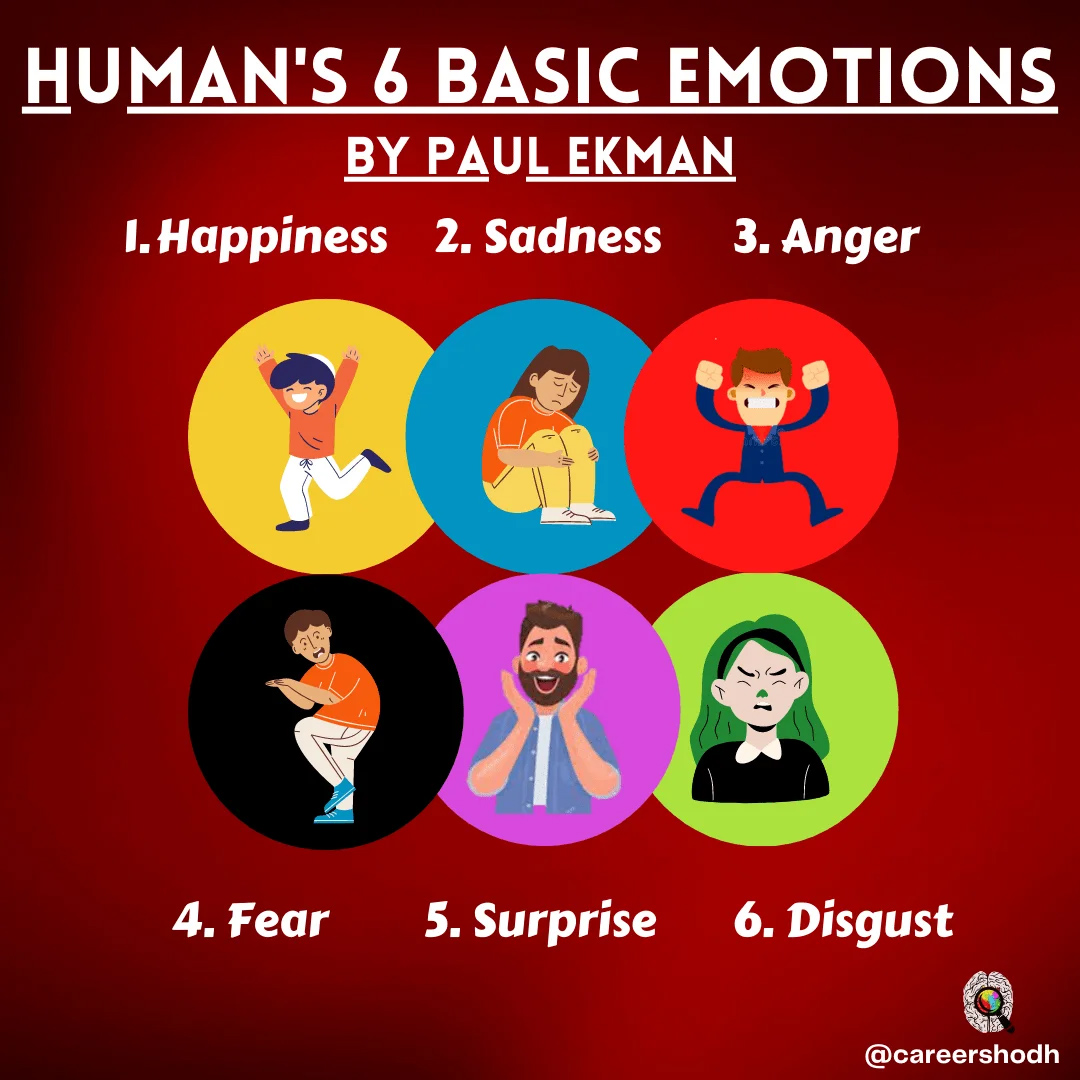
Paul Ekman*1934Emotional Expression
Ekman proved that facial expressions for basic emotions are universal and innate across all cultures. He described 6 basic emotions: fear, anger, disgust, sadness, happiness, and surprise. He later added contempt.
Motivation and Other Concepts
Motivation is an internal process that gives energy and direction to human behavior. It is closely linked to needs and goals.
Homeostasis
The state of internal balance within an organism. Motivation often functions as a mechanism to restore this balance (e.g., hunger drives us to eat).
Parapraxia (Freudian Slip)
An error in speech, memory, or physical action. According to Sigmund Freud, it is a manifestation of unconscious wishes or conflicts that break through to the surface at unexpected moments.
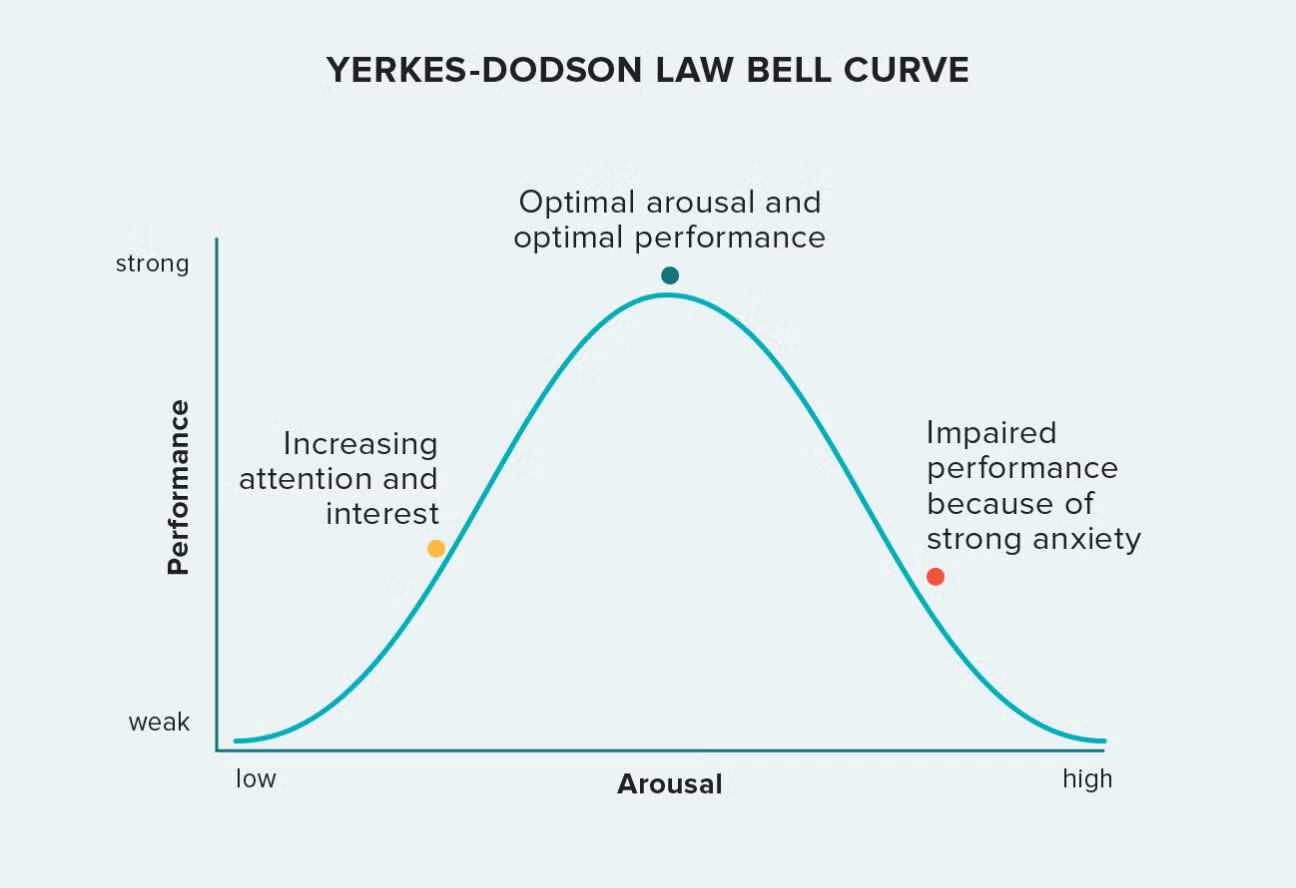
Yerkes-Dodson LawPerformance and Motivation
This law describes the relationship between the level of arousal (activation) and performance. The relationship takes the shape of an inverted U-curve. To achieve maximum performance, a moderate level of arousal is optimal. Both too low motivation (apathy) and too high motivation (panic, anxiety) impair performance.
Key Takeaways
Thinking: We distinguish between convergent (one solution) and divergent (creative) reasoning.
Creativity: Unfolds in the phases of preparation, incubation, illumination, and verification.
Language: Whorf's hypothesis states that language influences our cognitive categories.
Emotions: James-Lange emphasizes physiology, Cannon-Bard the brain, and Schachter-Singer cognitive interpretation.
Ekman: Defined 6 basic universal emotions.
Performance: The Yerkes-Dodson law states that a moderate level of arousal is required for the best performance.
In the psychology of creativity, there is a phase where we are not consciously focusing on the problem, but the solution 'ripens' in our unconscious. What is the technical term for this phase, and what immediately follows it?
Correct Answer: Incubation, followed by illumination.Explanation: Incubation is the second phase when we put the problem "on ice". It is immediately followed by the illumination phase, the sudden insight or Aha-experience, when the right solution occurs to us.
According to which theory of emotion do we feel fear solely because we have realized that our heart is pounding strongly and our hands are trembling in response to a dangerous stimulus?
Correct Answer: James-Lange theory.Explanation: The James-Lange theory is based on a peripheral principle, claiming that the subjective experience of an emotion is only a consequence of becoming aware of a physiological change in the body. The body reacts first, and the brain simply "reads" the emotion.