Introduction to the Topic
Personality
In psychology, personality refers to the relatively stable and unique system of psychological traits and characteristics of an individual that determine their distinctive behavior, thinking, and feeling, and shape their way of adapting to the environment.
Temperament and Constitutional Typology
Ivan Petrovich Pavlov1849–1936Typology of the Nervous System
Pavlov built upon the classical ancient typology (Hippocrates, Galen) but explained it using the properties of the nervous system. He focused on the strength, mobility, and balance of nervous processes (excitation and inhibition). From this, he derived four types that correspond to the classical ones: strong-unbalanced (choleric), strong-balanced-mobile (sanguine), strong-balanced-slow (phlegmatic), and weak (melancholic).
Hans Eysenck1916–1997PEN Model
Eysenck created one of the most influential personality models based on factor analysis. His PEN model includes three main dimensions: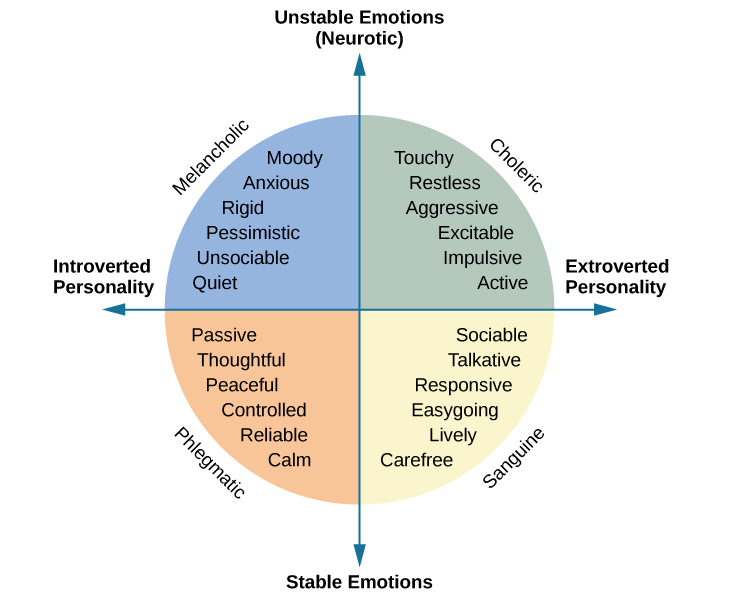
- Psychoticism: The degree of impulsivity, aggression, and lack of empathy vs. self-control.
- Extraversion / Introversion: Focus on the external world and society vs. focus on one's inner self.
- Neuroticism: Emotional instability and proneness to anxiety vs. emotional stability.
Exam Trap
Who invented introversion? The terms introversion and extraversion were first introduced and defined by Carl Gustav Jung. Eysenck did not invent these terms; he was simply the first to incorporate them into his measurable, psychometrically grounded model!
Constitutional TypologyBody Build and Personality
Some authors looked for a connection between body shape and personality traits (these models are now obsolete but historically significant).
- Ernst Kretschmer: Described three body types and their associated predispositions to mental illnesses – pyknic (prone to manic-depression), asthenic (prone to schizophrenia), and athletic (prone to epilepsy).
- William Sheldon: An American psychologist who defined types based on embryonic development – endomorph (soft, rounded), ectomorph (slender, fragile), and mesomorph (muscular).
Personality Traits and Intelligence
Big Five Model (Five-Factor Model)Personality Structure
Currently the most widely accepted and empirically supported model of personality traits. The acronym OCEAN represents five broad dimensions: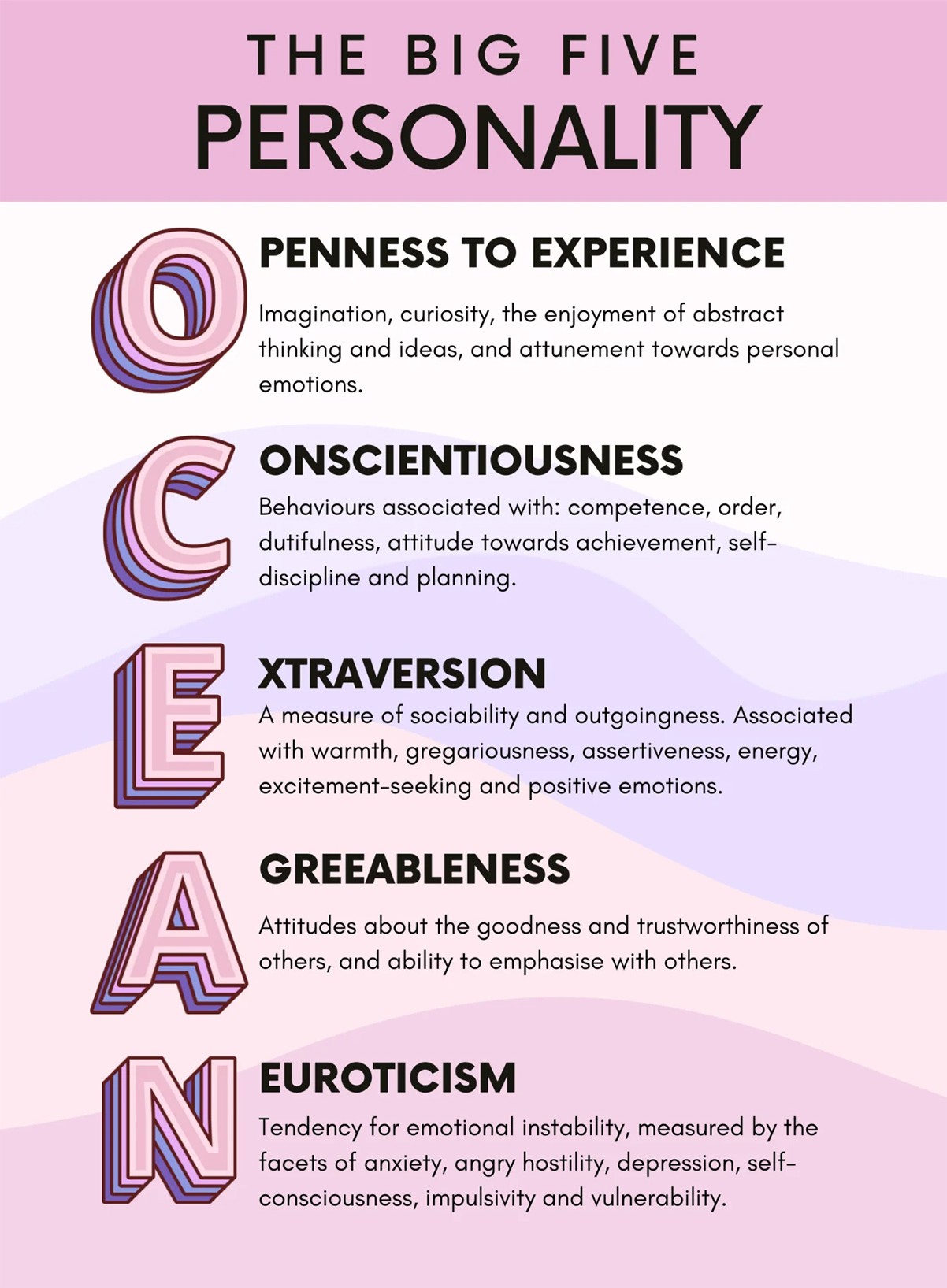
- Openness to Experience
- Intellectual curiosity, creativity, and a willingness to try new things.
- Conscientiousness
- Goal-directedness, reliability, self-control, and a sense of duty.
- Extraversion
- Sociability, assertiveness, energy, and seeking stimulation from the environment.
- Agreeableness
- Trustfulness, altruism, and a willingness to help and cooperate with others.
- Neuroticism
- Emotional instability, a tendency to experience negative emotions such as anxiety or sadness.
Raymond Cattell1905–1998Components of Intelligence
In addition to creating the 16-factor personality model (16PF), Cattell is famous for dividing general intelligence into two components:
- Fluid Intelligence: Biologically innate, independent of culture and education. The ability to solve new problems and think abstractly. It naturally declines with age.
- Crystallized Intelligence: Acquired throughout life through learning and experience (vocabulary, factual knowledge). Conversely, it increases with age and experience.
Exam Trap
The statement "Intelligence relentlessly declines with age" is considered inaccurate/incorrect in entrance exams. Only the fluid component of intelligence declines, while the crystallized component can continue to grow well into old age.
Evolution of the Concept of IntelligenceMeasuring IQ
- William Stern
- The first to propose the equation for calculating the intelligence quotient (IQ): mental age divided by chronological age, all multiplied by 100.
- Howard Gardner
- Challenged the idea of a single, unified IQ and proposed the theory of multiple intelligences (e.g., musical, spatial, interpersonal, logical-mathematical).
Personality Dynamics and Psychoanalysis
Sigmund FreudStructural ModelPsychoanalysis
Freud divided personality into three agencies: Id (drives, pleasure principle), Ego (the rational self, reality principle), and Superego (morality, conscience, perfection principle). The Ego constantly faces pressures from both the Id and the Superego, and to protect itself from anxiety, it unconsciously uses so-called defense mechanisms.
- Regression
- Returning to a lower, developmentally earlier stage of behavior when faced with stress (e.g., an adult crying and whining when under pressure).
- Projection
- Attributing one's own unacceptable feelings or desires to other people (e.g., an aggressive person claiming that everyone else is threatening and provoking them).
- Sublimation
- Transforming an unacceptable drive (aggression or sex) into a socially acceptable, creative activity (e.g., aggression channeled into professional sports).
Exam Trap
Projection is an Ego defense mechanism, NOT a cognitive operation! Tests often try to confuse students by categorizing projection as a logical process or a perceptual error. Remember that it is an unconscious psychoanalytic defense.
Humanistic and Cognitive Approach
Abraham Maslow1908–1970Humanistic Psychology
Creator of the hierarchy of needs. He argued that an individual must first fulfill lower deficiency needs (physiological, safety, love, esteem) before they can achieve the highest growth need – self-actualization (fulfilling one's own potential).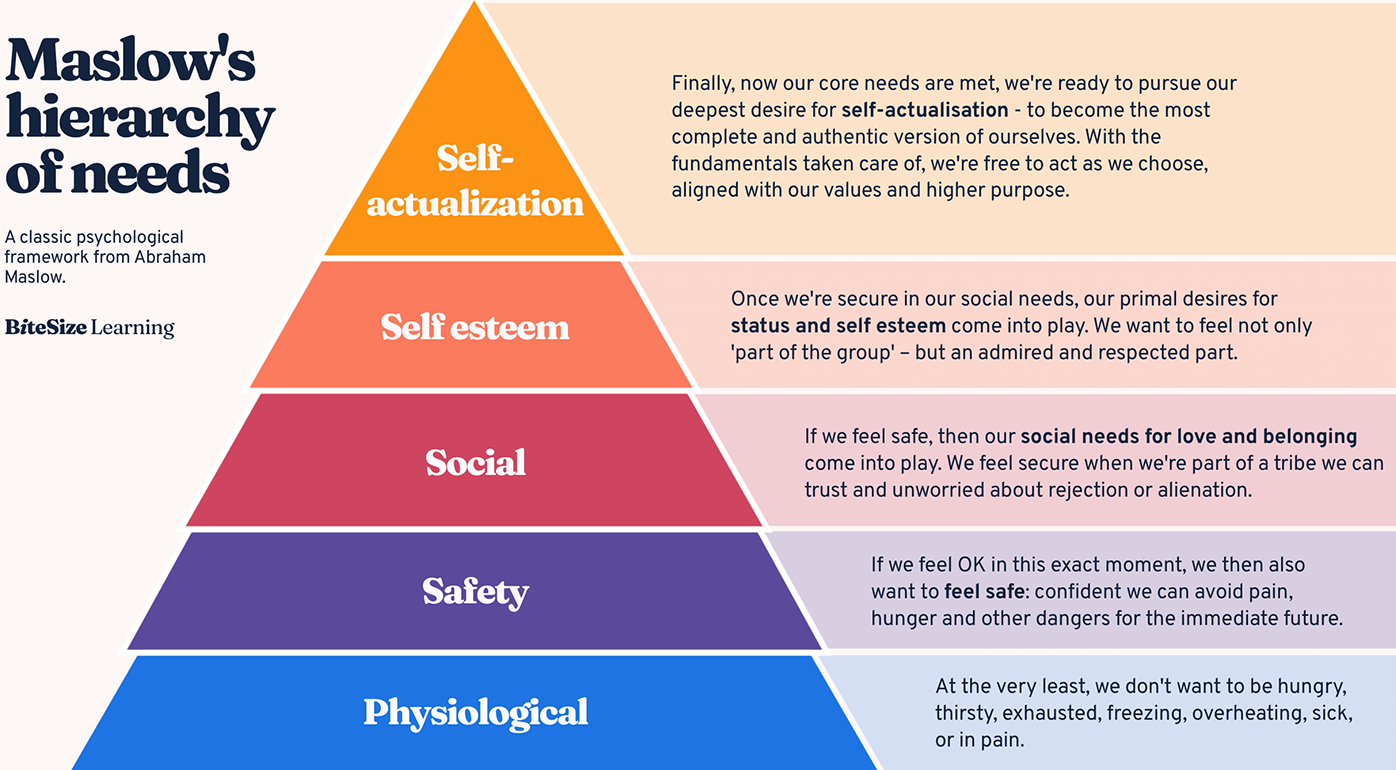
Carl Rogers1902–1987Phenomenological Approach
Emphasized that a healthy personality requires a state called congruence (alignment between our real and ideal self) and experiencing unconditional positive regard from others.
Julian Rotter1916–2014Social Learning Theory
Introduced the concept of Locus of Control, which describes how people attribute control over their lives.
- Internal locus of control
- A person believes that they control their own life and successes through their own efforts.
- External locus of control
- The belief that life is controlled by fate, chance, or powerful others.
Martin Seligman*1942Positive Psychology
Discovered the phenomenon of learned helplessness – a state where an organism, after repeated experiences with uncontrollable stress, stops trying to escape even when a solution becomes available. This concept is often linked to the onset of depression.
Key Takeaways
- Temperament: I. P. Pavlov based his types on the properties of the nervous system (strength, balance, mobility). Eysenck created the PEN model and popularized the terms introversion and extraversion, which were originally introduced by C. G. Jung.
- Personality Traits: Currently, the most widely accepted model is the Big Five (OCEAN: Openness, Conscientiousness, Extraversion, Agreeableness, Neuroticism).
- Intelligence: R. Cattell divided it into innate (fluid), which declines with age, and acquired (crystallized), which instead grows with experience and knowledge.
- Defense Mechanisms: According to Freud, they are used by the Ego to protect against anxiety. Examples include projection, regression, and sublimation.
- Humanistic View: A. Maslow created a pyramid of needs culminating in self-actualization. J. Rotter introduced the concept of Locus of Control, examining the center of control over one's life.
During the aging process, specific changes occur in human intelligence, which were described by R. Cattell. Which of the following definitions correctly describes the component of intelligence that increases with age and learning?
Correct Answer: Crystallized intelligenceExplanation: Crystallized intelligence is the component that reflects the accumulation of life experiences, factual knowledge, education, and acquired vocabulary. Unlike innate, fluid intelligence (logical abstract thinking and flexibility), which declines with age, crystallized intelligence can continue to increase throughout one's life.
Imagine a student who gets an F in math and immediately declares: 'That teacher hates me, and besides, the test was deliberately unfair!' If we were describing this phenomenon within the cognitive theory of personality according to Julian Rotter, what concept is this student demonstrating?
Correct Answer: External locus of controlExplanation: Julian Rotter introduced the concept of Locus of Control. An individual with an external locus of control attributes the responsibility for their successes or failures to factors outside themselves – powerful others (the teacher, the system) or chance and fate. Conversely, a person with an internal locus of control would look for the cause within themselves (e.g., 'I didn't study enough').