Developmental psychology investigates the physical, cognitive, emotional, and social changes that occur in humans throughout their entire life cycle – from conception to death.
This discipline seeks to understand what factors (innate genetic predispositions versus environmental influences) shape our growth and behavior at different stages of life. The core topics for entrance exams are primarily theories of cognitive, moral, and psychosocial development.
Cognitive Development
How does a child learn about the world and how does their thinking change? These questions were answered by two prominent theorists whose views complement each other.
Jean Piaget1896–1980Cognitive Development
A Swiss psychologist who believed that children actively construct their understanding of the world. Adaptation to the environment, according to him, occurs through two complementary mechanisms:
Assimilation: Incorporating a new experience into existing cognitive structures (e.g., a child knows what a dog is, sees a sheep, and calls it a dog).
Accommodation: Changing or creating a new cognitive structure based on a new experience (the child realizes the sheep is different from a dog and creates a new category for it).
Piaget divided cognitive development into four qualitatively distinct stages:
1
1. Sensorimotor Stage (0–2 years)
The child explores the world through senses and motor skills. The major milestone is understanding object permanence (the object exists even when out of sight).
2
2. Preoperational Stage (2–7 years)
Development of language and symbolic thinking. Typical features include egocentrism (inability to see things from another's perspective) and magical thinking.
3
3. Concrete Operational Stage (7–11 years)
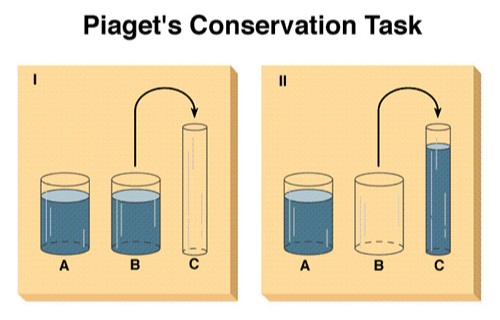
The child masters logical operations with concrete objects. The key discovery is conservation – understanding that the amount of liquid remains the same even when poured into a differently shaped glass.
4
4. Formal Operational Stage (from 11 years)
The ability for abstract and hypothetico-deductive reasoning emerges.
Lev S. Vygotsky1896–1934Sociocultural Approach
A Russian psychologist who emphasized that cognitive development is primarily a social and cultural process.
Internalization
The process by which a child adopts and absorbs social rules, concepts, and language from their surroundings into their own internal thinking.
Zone of Proximal Development
The difference between what a child can solve independently and what they can achieve with the guidance of a more competent adult or peer.
Exam Trap
Piaget vs. Vygotsky: While Piaget viewed development as a more or less biologically mature process of a "solitary scientist," Vygotsky placed absolute emphasis on environmental factors, social interaction, and language acquisition.
Moral Development
Closely related to cognitive development is the development of the ability to distinguish right from wrong. The most famous model was created by Lawrence Kohlberg based on research with moral dilemmas.
Lawrence Kohlberg1927–1987Moral Development
Kohlberg defined three main levels of moral development:
1
1. Preconventional Level
Morality is determined by external consequences. Good behavior is that which leads to a reward; bad behavior is that which is followed by punishment (obedience and punishment orientation).
2
2. Conventional Level
Morality is determined by social norms, laws, and the desire to meet the expectations of others. We want to be a "good boy/girl".
3
3. Postconventional Level
Morality is guided by universal ethical principles (e.g., the right to life, justice) that can stand even above formal law.
Exam Trap
A synonym for the postconventional level is the principled level. This exact term appears in many tests, so remember to associate it with the highest stage of Kohlberg's theory.
Psychosexual vs. Psychosocial Development
Two giants of psychology described personality development in entirely different ways.
Sigmund Freud1856–1939Psychosexual Development
According to Freud, development is determined by the shifting of sexual energy (libido) to different erogenous zones of the body. He defines 5 stages:
1. Oral Stage
Pleasure is centered in the mouth (sucking, biting). Infancy period.
2. Anal Stage
Focus on withholding and expelling feces. Toddler period.
3. Phallic Stage
Interest in genitals. Children experience the Oedipus or Electra complex.
4. Latency Stage
Calming of drives. Energy is redirected to school, learning, and peers (from age 6 to puberty).
5. Genital Stage
With the onset of puberty, mature partner-oriented sexuality awakens.
Erik H. Erikson1902–1994Psychosocial Development
Erikson formulated the "theory of the eight stages of man". Every period of life is accompanied by a specific psychosocial crisis (e.g., Trust vs. Mistrust in infants, Identity vs. Role Confusion in adolescence). Successfully overcoming a crisis leads to acquiring a specific virtue.
Epigenetic Principle
The assumption that our development unfolds in a predetermined, innate sequence of stages that progressively build upon one another.
Exam Trap
The End of Development: While Freud's personality development essentially ends in adolescence (with the genital stage) and personality is almost exclusively determined by childhood, Erikson's psychosocial development is lifelong (ending only with the 8th crisis in late adulthood).
Early Social Behavior and Attachment
Our ability to form relationships in adulthood is strongly shaped in the very first year of life.
Attachment TheoryJohn Bowlby and Mary Ainsworth
Examines the emotional bond that forms between a child and their primary caregiver (most often the mother). The type of attachment was tested using the "Strange Situation" experiment.
Secure Attachment
The child trusts the mother, is sad when she leaves, but quickly calms down upon her return. Leads to healthy relationships in adulthood.
Avoidant Attachment
The child shows no signs of stress when the mother leaves and ignores her upon return (has learned they cannot rely on her).
Anxious-Ambivalent Attachment
The child is extremely distressed when the mother leaves, but pushes her away and is angry upon her return.
Disorganized Attachment
Confused and contradictory behavior, often found in abused or neglected children.
René SpitzConsequences of Deprivation
Discovered the devastating consequences of a lack of maternal love and physical contact for children.
Hospitalism
The physical and psychological wasting away of children in institutional care, despite having adequate food and hygiene.
Anaclitic Depression
A severe depressive state an infant falls into if suddenly separated for an extended period from a mother with whom they have already formed a bond.
Newborn Reflexes
Innate automatic survival responses. These include the sucking, rooting, grasping, and Moro (startle) reflexes. These reflexes gradually disappear as the brain develops.
Theory of Mind
The ability to understand that other people have their own beliefs, desires, and intentions that differ from our own. Begins to develop around the age of 4.
Key Takeaways
Cognitive Development: Piaget divided development into 4 stages (sensorimotor, preoperational, concrete, and formal operational). Assimilation and accommodation are the core processes. Vygotsky emphasized social interaction and language (internalization).
Moral Development: Kohlberg divided it into preconventional, conventional, and postconventional (principled) levels.
Erikson vs. Freud: Erikson's psychosocial personality development lasts a lifetime (8 crises) and follows the epigenetic principle, whereas Freud's psychosexual development ends in adolescence.
Attachment: The emotional bond with the mother in early childhood (secure, avoidant, ambivalent, disorganized) shapes our future romantic relationships.
In which of the cognitive stages according to Jean Piaget does a child typically exhibit 'egocentrism', meaning the inability to view reality from another person's perspective?
Correct Answer: In the preoperational stage.Explanation: The preoperational stage (roughly from 2 to 7 years) is characterized by the development of symbolic thinking and language. However, the child cannot yet perform logical cognitive operations and perceives the world highly egocentrically (believing others see and think exactly what they do).
Which psychologist defined personality development as a series of eight psychosocial crises that occur throughout the entire lifespan based on the so-called epigenetic principle?
Correct Answer: Erik H. Erikson.Explanation: Erikson expanded upon Freud's theory, shifting the focus from sexuality to the social environment and lifelong development (from trust vs. mistrust in infancy to integrity vs. despair in old age).