Social psychology is the scientific study of how individuals' thoughts, feelings, and behaviors are influenced by the actual, imagined, or implied presence of others.
While personality psychology looks for the causes of behavior inside the person (in their traits), social psychology focuses on the power of the situation and how strongly social context can alter even the most stable personality traits.
Famous Social Experiments and Influence
The second half of the 20th century brought a series of groundbreaking (and from today's ethical standpoint, often controversial) experiments that revealed both the dark and compliant sides of human nature.
Solomon Asch1907–1996Conformity
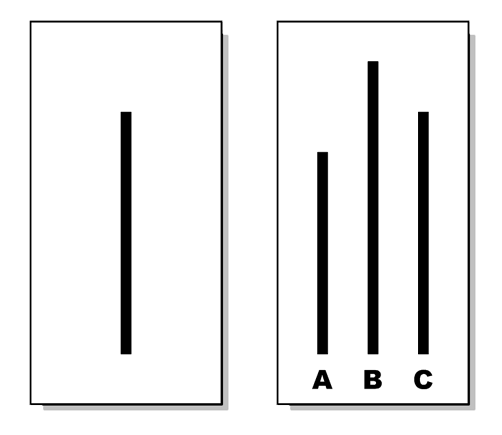
Asch conducted a classic experiment involving the estimation of line lengths. He studied conformity, the tendency of an individual to change their opinions and behavior to align with the majority group. It showed that a large portion of people would rather consciously give an incorrect answer than stand out from the crowd and face social pressure.
Stanley Milgram1933–1984Obedience to Authority
Milgram's experiment is among the most famous in the history of psychology. He investigated the willingness to obey an authority figure's command to perform an act conflicting with personal conscience. Participants, acting as "teachers," were to administer supposed electric shocks to "learners" for incorrect answers. The vast majority (over 60%), under pressure from the experimenter, went all the way to the lethal limit of 450 volts.
Philip Zimbardo*1933Influence of Role and Situation
The author of the famous Stanford Prison Experiment (1971). He randomly assigned students to the roles of "guards" and "prisoners" in a simulated prison. The experiment had to be terminated prematurely after six days because the guards began to cruelly abuse the prisoners. With this, Zimbardo demonstrated the Lucifer Effect – how a powerful social situation and an assigned role can turn ordinary, good people into monsters.
Groups, Crowds, and Social Behavior
A group is not just the sum of its members. A person often behaves completely differently in a group than they would as an isolated individual.
Gustave Le Bon1841–1931Crowd Psychology
A French sociologist who described how a person in a crowd loses their rationality and individuality (so-called deindividuation). The crowd is governed by primitive emotions, instincts, and suggestion. The feeling of anonymity in a crowd reduces personal responsibility, which can lead to aggressive and destructive behavior.
Kurt Lewin1890–1947Field Theory and Leadership
The founder of modern social psychology. His field theory states that human behavior is the result of the interaction between the individual and their life space (social field). In experiments with groups of boys, he described three basic leadership styles:
Autocratic (Authoritarian)
The leader makes decisions alone, without allowing discussion. Leads to high output, but also to aggression and group apathy.
Democratic
The leader consults with the group, and decisions are shared. Output is stable, and the group shows the highest satisfaction and creativity.
Laissez-faire (Liberal)
The leader does not intervene in activities, giving the group free rein. Usually leads to chaos, uncertainty, and the lowest output.
Beyond specific authors' theories, social psychology defines other key phenomena of group behavior:
Bystander Effect
A phenomenon where the presence of other people decreases the likelihood that someone will help a victim in distress. It is caused by the diffusion of responsibility.
Social Loafing (Ringelmann Effect)
The tendency for people to exert less effort when working in a group (when their individual performance is lost in the whole) than when working alone.
Altruism
Selfless prosocial behavior where a person helps others even at their own cost or risk, without expecting a reward.
Social Perception (Perceiving Others)
The way we form impressions of other people is full of biases, stereotypes, and mental shortcuts.
Errors in Social PerceptionCognitive Biases
Fundamental Attribution Error
The strong tendency to attribute other people's behavior to their internal, personality traits (they are mean, lazy) while underestimating the influence of external situational factors (they had a hard day, are under pressure).
Halo Effect
An error where one prominent trait (e.g., physical attractiveness) completely overshadows other traits and influences our overall evaluation of a person.
Projection
Attributing our own, often unconscious or negative traits, intentions, and feelings to other people.
Pygmalion Effect (Self-fulfilling Prophecy)
A phenomenon where our (even unfounded) expectations of another person alter our behavior toward them so much that it causes that person to behave in a way that confirms our original expectation.
Exam Traps
Watch out for these details:
Projection: It appears in tests as an error in social perception, but remember that it is primarily Freud's defense mechanism of the Ego.
Fundamental Attribution Error: We always overestimate internal (dispositional) traits at the expense of external (situational) influences.
Attitudes and Cognitive Dissonance
An attitude is an enduring tendency to respond in a certain (positive or negative) way to people, objects, or situations.
Structure of an AttitudeComponents of Attitude
A question about the structure of an attitude is an absolute classic on entrance exams. An attitude always has three components:
Cognitive component
What we know about the object, our rational beliefs, thoughts, and information.
Affective component
What we feel about the object, our emotions, and likes/dislikes.
Conative (Behavioral) component
How we actually behave or tend to behave toward the object (readiness to act).
Leon Festinger1919–1989Cognitive Dissonance
Festinger described one of the most influential phenomena in psychology. Cognitive dissonance is the unpleasant state of internal tension that arises when our attitudes, beliefs, and behaviors are in conflict (e.g., I know smoking kills, but I still smoke). To relieve this tension, a person must either change their behavior (stop smoking) or rationalize and adjust their attitude (convince themselves it's not that harmful).
Key Takeaways
Experiments: Asch demonstrated the power of conformity, Milgram blind obedience to authority, and Zimbardo the drastic impact of social roles and situations.
Crowds and Groups: Le Bon defined deindividuation in a crowd. Lewin described three leadership styles (autocratic, democratic, laissez-faire).
Phenomena: The bystander effect (diffusion of responsibility) explains the reluctance to help in the presence of others. Social loafing describes decreased effort during group work.
Perception: The fundamental attribution error (overestimating traits, underestimating situations), the Halo effect, and the Pygmalion effect are among the most common biases.
Attitudes: They consist of cognitive, affective, and conative components. A conflict between them and behavior leads to cognitive dissonance (Festinger).
Within the structure of attitudes, we distinguish three components. If we look at a person who has a phobia of spiders and observe that they have a tendency to immediately run away from a spider or crush it, which component of the attitude are we describing?
Correct Answer: The conative (or behavioral) component.Explanation: The conative component of an attitude represents our actual actions or readiness to act toward a given object (here, the tendency to flee or attack). In contrast, the feeling of disgust or fear would be the affective component, while the rational belief that the spider might be poisonous would represent the cognitive component.
Which famous social psychology experiment was primarily focused on investigating conformity by comparing the lengths of differently sized line segments in front of a group of actors who were clearly giving incorrect answers?
Correct Answer: Asch's experiment (Solomon Asch).Explanation: Solomon Asch investigated conformity, meaning the influence of majority pressure on an individual's opinion. Milgram's electric shock experiment studied obedience to authority, while Zimbardo's simulated prison experiment examined the influence of context and the assumption of a social role.